

Published April 4, 2026
How to Sell Your House in Nassau County, NY in 2026 — What Long Island Home Sellers Actually Need to Know

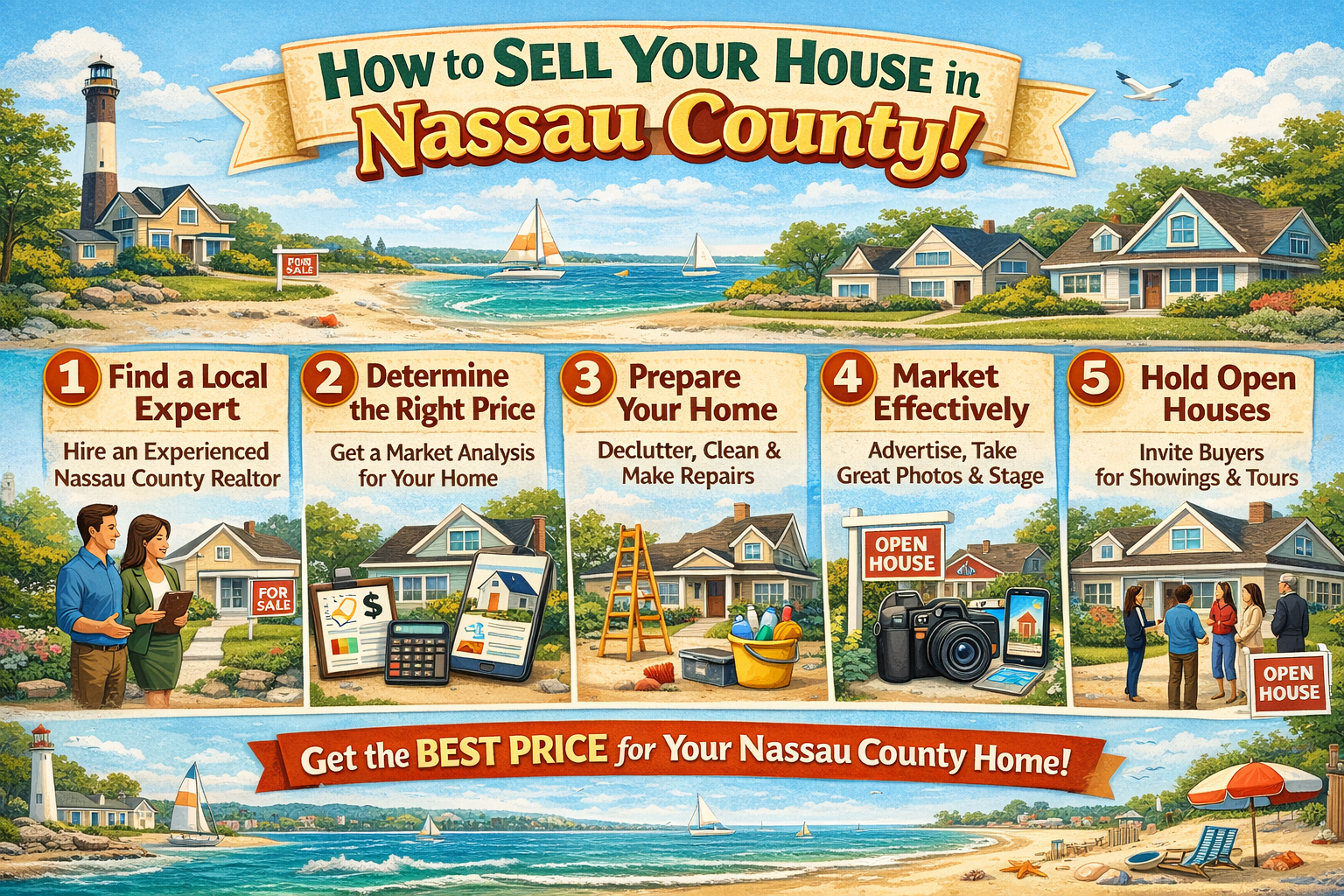
How to Sell Your House in Nassau County, NY in 2026 — What Long Island Home Sellers Actually Need to Know
By Alex Baron · Associate Broker, The Baron Team at Keller Williams · Updated April 2026
Understanding the Nassau County Real Estate Market in 2026
Nassau County stretches from the Queens border to the Suffolk County line, and the real estate market shifts dramatically depending on where you are within it. Great Neck, Manhasset, and Garden City carry different buyer expectations — and different pricing dynamics — than Levittown, Valley Stream, or Elmont. Treating Nassau as a monolith is one of the costliest mistakes a seller can make.
In 2026, Nassau County continues to benefit from sustained demand driven by buyers priced out of New York City, families seeking top-ranked school districts, and professionals who want proximity to Manhattan without city living. The Long Island Rail Road connection remains one of the county's most powerful selling points — and smart sellers know how to leverage it in their listing strategy.
Supply remains the dominant story. Nassau County's inventory has been historically tight for several years running, and 2026 is no exception. That's good news for sellers — but only for those who price correctly and present their homes with the level of polish today's Nassau buyers expect.
| Nassau County's school districts are not just an amenity — they are a pricing variable. The same square footage in a top-ranked district can command $100,000 or more over an identical home two miles away. Your listing agent must know how to quantify and market this premium correctly. |
How to Price a Nassau County Home in 2026 — The Long Island Seller's Biggest Decision
Pricing a Nassau County home is an exercise in precision. Unlike broad metro markets where general trends apply, Long Island pricing is hyperlocal — down to the school district, the block, and in some cases the side of the street. Getting it wrong in either direction is expensive.
Here's what an intelligent Nassau County pricing strategy looks like in 2026:
1. Know your school district premium precisely. Buyers in Nassau County are intensely school-district-driven. A home in the Great Neck, Jericho, Syosset, or Herricks district commands a measurable premium that needs to be built into your list price — and defended during negotiation. Your agent should have sold data that isolates this variable.
2. Separate your property taxes from your list price narrative. Nassau County property taxes are among the highest in the nation. Buyers will factor this into their monthly payment calculations immediately. Knowing your tax grievance history, your STAR exemption status, and your tax class designation gives your agent the tools to address objections before they kill a deal.
3. Anchor to 60-day sold comps within your specific zip code. Nassau's micro-markets move independently. What happened in Rockville Centre last quarter may have no bearing on what's happening in Mineola today. Comps must be recent, local, and matched to your property type — single-family, colonial, cape, ranch, hi-ranch, or split-level all carry different buyer pools.
4. Price to generate activity in the first two weeks. In Nassau County, a listing that sits beyond 21 days without an accepted offer begins to develop a stigma. Buyers and their agents notice days-on-market. A strategic list price that generates early showings and offers is almost always worth more net at closing than an aspirational price that triggers a slow bleed of reductions.
Preparing Your Nassau County Home for Sale: What Matters Most to Long Island Buyers
Nassau County buyers in 2026 are well-researched and often well-funded. They've been watching the market for months. They know what comparable homes look like, and they have specific expectations about condition, layout, and presentation. Here's where to focus your energy before you list:
Kitchens and Bathrooms: The Nassau County Buyer's Litmus Test
Nassau County buyers at nearly every price point are evaluating kitchens and bathrooms as their primary quality indicators. You don't need a full renovation — but dated hardware, old fixtures, worn grout, and chipped tile all register as deferred maintenance in a buyer's mind and translate directly into lower offers. A targeted refresh costing a few thousand dollars can protect tens of thousands in negotiated price reductions.
Basements and Attics: Nassau's Hidden Equity
Finished basements and usable attic space are significant value drivers in Nassau County, where square footage is at a premium and extended family living arrangements are common. If your basement is finished and legal, make sure it's clean, bright, and clearly presented in your listing. If it's unfinished, a clean, dry, well-lit space still reads better than a cluttered storage area.
Outdoor Space and Curb Appeal on Long Island
Nassau County buyers place significant value on outdoor living space — whether that's a yard, patio, deck, or pool. Before listing, address any obvious deferred maintenance: paint the front door, edge the lawn, power wash the driveway, and if you have a pool, make sure it's clean and operational. First impressions in Nassau County are formed at the curb, not the front door.
| PRO TIP FROM ALEX BARON If your Nassau County home has a Certificate of Occupancy issue — a permit that was pulled but never closed, an addition without documentation, or a converted garage — address it before you list, not during the buyer's attorney review. Undisclosed CO issues are one of the leading deal-killers in Nassau County real estate transactions. |
Marketing a Nassau County Home in 2026: How The Baron Team Drives Maximum Exposure
Nassau County buyers come from multiple channels simultaneously — relocating New York City residents, move-up buyers already in Long Island, out-of-state buyers targeting the tri-state area, and investors looking for income-producing properties. A marketing plan that only addresses one of those channels will miss the others.
Cinematic Video and Professional Photography
Nassau County buyers are sophisticated online researchers. Many are touring homes virtually before committing to an in-person showing. Cinematic video walkthroughs, aerial drone footage for homes with outdoor space, and professional photography that captures a home's scale and natural light are not optional at any price point in Nassau County — they are the baseline that serious buyers expect.
OneKey MLS Positioning and Agent-to-Agent Outreach
Nassau County transactions flow heavily through the agent-to-agent network. Buyers' agents in Long Island are active, connected, and quick to bring qualified clients to listings that their colleagues flag as exceptional. An experienced Nassau County listing agent doesn't wait for buyers to find the listing — they proactively present it to the agents most likely to have a matching buyer in their pipeline.
Digital Advertising Targeted to Nassau County Buyer Profiles
The Baron Team's digital advertising strategy for Nassau County listings is built around specific buyer profiles — not broad geographic targeting. We identify buyers by commute radius, household income, school district interest, and behavioral signals that indicate active home search activity. Your listing reaches the right buyers across Facebook, Instagram, and Google — not just whoever happens to scroll past.
Negotiating Offers on Your Nassau County Home: The Details That Determine Your Net
Nassau County real estate transactions come with layers that many sellers don't anticipate until they're in the middle of them. Understanding what to expect — and having an agent who can navigate it — is the difference between a smooth closing and a deal that falls apart at the attorney review stage.
Here's what experienced Nassau County sellers know about the offer and negotiation process:
5. Attorney review is where Nassau County deals get complicated. Unlike some markets, Nassau County transactions involve attorneys on both sides who negotiate contract terms after the offer is accepted. Price is only one variable. Closing timeline, personal property inclusions, post-closing occupancy, and contingency language are all renegotiated at this stage. Your listing agent needs to stay actively involved through attorney review — not disappear after the offer is signed.
6. Home inspection findings are a second negotiation — prepare for it. Nassau County homes, particularly those built in the 1950s through 1970s, routinely produce inspection reports with oil tank notations, knob-and-tube wiring flags, and aging roof or HVAC systems. Your agent should help you decide in advance which items you'll address, which you'll credit, and which you'll hold firm on — before the buyer's inspector even shows up.
7. Appraisal risk is real in a rapidly appreciating market. When Nassau County homes sell above asking price in competitive bidding situations, appraisals don't always follow. A seasoned listing agent will advise you on appraisal gap risk, help you evaluate buyers' financial strength, and structure the contract in a way that protects you if the appraisal comes in low.
8. Net sheet analysis before you say yes. Every offer on your Nassau County home should be evaluated on net proceeds — not headline price. Transfer taxes, attorney fees, outstanding liens, and closing cost credits all affect what lands in your account. Your agent should run a full net sheet on every offer before you respond.
| Nassau County sellers who work with an agent who knows this market's legal, structural, and procedural nuances consistently close faster and with fewer surprises than those who don't. Experience in this specific county is not a luxury — it's a financial advantage. |
Nassau County-Specific Selling Considerations
Property Taxes: Nassau County's Most Discussed Variable
Nassau County property taxes are consistently among the highest in the United States. For buyers calculating their monthly carrying cost, taxes are often more impactful than the difference between two interest rate points. A smart seller understands their current assessment, their tax grievance history, and whether there's a pending grievance that will transfer to the buyer. Providing this information proactively builds buyer confidence and reduces the chance of last-minute renegotiation.
Oil Tanks: A Nassau County Reality
A significant percentage of Nassau County homes — particularly those built before 1980 — either have or had underground oil storage tanks. Buyers and their lenders are acutely aware of this. If your home has an abandoned UST or an active above-ground tank, your agent needs to know how to position this correctly in the listing and manage buyer concerns before they escalate into deal-breakers.
LIRR Proximity: Asset or Obstacle Depending on the Buyer
Long Island Rail Road access is one of Nassau County's most compelling selling points for commuter buyers — and an irrelevant factor for remote workers or retirees. Knowing your buyer profile and marketing your LIRR proximity to the right audience (or downplaying train noise for buyers who aren't commuters) is a nuance that only an experienced Nassau County agent will handle correctly.
How to Choose the Right Listing Agent for Your Nassau County Home
The Nassau County real estate market rewards sellers who choose their agent based on demonstrated local expertise — not the biggest sign, the loudest advertisement, or a family connection. The right agent for your Nassau County home sale has sold homes in your specific neighborhood, understands your micro-market's pricing dynamics, and has a proven marketing infrastructure ready to deploy the moment you sign.
Ask every agent you interview these four questions:
9. "How many Nassau County homes have you personally sold in the last 12 months, and in which towns?" An agent with a strong Queens track record but no Nassau history is learning your market on your dime.
10. "How do you handle attorney review, and how involved are you during that process?" An agent who hands off to the attorneys and goes silent is an agent who loses deals they should have saved.
11. "What is your average days-on-market for Nassau County listings?" Speed to contract is a direct reflection of pricing accuracy and marketing effectiveness. Ask to see the data.
12. "Show me your full marketing plan for my home — not the template, the actual plan." A serious listing agent should be able to walk you through exactly how they will create demand for your specific property from day one.
Frequently Asked Questions: Selling a House in Nassau County, NY
How long does it take to sell a house in Nassau County in 2026?
Correctly priced Nassau County homes in desirable school districts are routinely going into contract within one to three weeks of listing in 2026. The full transaction timeline — from accepted offer through attorney review, inspection, mortgage commitment, and closing — typically runs 60 to 90 days in Nassau County, longer than many other markets due to the attorney review process and the volume of steps involved in a Long Island closing.
What are the seller closing costs in Nassau County, NY?
Nassau County sellers should expect to pay New York State transfer tax, agent commissions, attorney fees, and any outstanding liens or municipal charges at closing. If your sale price exceeds $1 million, an additional mansion tax applies — though this is technically paid by the buyer, it often enters negotiations. Total seller-side costs in Nassau County typically range between 7% and 10% of the sale price depending on circumstances. Ask your agent for a personalized net sheet before you list.
Is now a good time to sell in Nassau County?
2026 continues to favor Nassau County sellers. Inventory remains constrained, buyer demand from New York City residents seeking more space is sustained, and the county's school districts and commuter infrastructure keep it at the top of Long Island buyer wish lists. That said, "a good time to sell" is always relative to your specific property, neighborhood, condition, and financial goals. A confidential conversation with an experienced Nassau County listing agent will give you a realistic picture.
What is my Nassau County home worth in 2026?
Nassau County home values vary enormously by town, school district, property type, and condition. The only way to get an accurate picture is through a Comparative Market Analysis based on recent, locally-matched sold data. The Baron Team provides complimentary, no-obligation home valuations for Nassau County homeowners — with specific attention to school district premiums, tax impact, and current buyer demand in your neighborhood.
| Ready to Sell Your Nassau County Home? Get a confidential, no-obligation home valuation from Alex Baron — serving Nassau County and Long Island for 38+ years with $500M+ in career sales and over 1,000 successful closings. We'll show you exactly what your home is worth and what it will take to maximize your results in today's market. Call or text: 718-490-4523 · wesellhomes.pro |